
Practical exercises to train and strengthen your diaphragm.
- Lætitia

- Feb 14
- 10 min read
Diaphragm dysfunction reduces breathing efficiency, causing fatigue and shortness of breath. Strengthening it through diaphragmatic breathing, controlled exercises, posture improvement, and inspiratory muscle training can restore function and improve respiratory health. Consistent practice nurtures this vital muscle, much like tending to the roots of a tree to support its growth and resilience.

How Diaphragm Dysfunction Affects Breathing
Reduced Lung Expansion
If the diaphragm is weak or paralyzed, it cannot contract fully or effectively.
This limits the expansion of the thoracic cavity, reducing lung volume and the amount of air inhaled. Result: shortness of breath, shallow breathing, and decreased oxygen intake.
Compensatory Breathing Patterns
Other muscles (like neck, chest, and shoulder muscles) may overwork to compensate.
This leads to inefficient, labored breathing and increased fatigue.
Over time, this can cause muscle strain and discomfort.
Impaired Gas Exchange
Poor diaphragm function reduces airflow, leading to insufficient oxygen delivery and carbon dioxide removal. This can cause hypoxia (low oxygen levels) and hypercapnia (excess carbon dioxide), affecting organ function.
Impact on Posture and Core Stability
Dysfunction weakens core stability since the diaphragm is part of the core muscle group.
This can lead to poor posture, back pain, and further respiratory inefficiency.
Associated Health Conditions
Diaphragm dysfunction can result from:
Neurological disorders (e.g., spinal cord injury, phrenic nerve damage)
Chronic lung diseases (e.g., COPD, asthma)
Surgical complications or trauma
It may cause or worsen respiratory failure in severe cases.

How to Strengthen the Diaphragm
Strengthening the diaphragm improves breathing efficiency, core stability, and overall health. Here are effective strategies:
Diaphragmatic (Belly) Breathing
Benefits: Encourages full diaphragm engagement, increases lung capacity, and reduces reliance on accessory muscles. See bellow for more details on how to do it.
Practice 5–10 minutes daily.
Controlled Breathing Exercises
Pursed-lip breathing: Inhale through the nose, exhale slowly through pursed lips to control airflow and improve oxygen exchange.
Breath holding and slow exhalation: Helps increase diaphragm strength and lung endurance.
Postural Awareness and Core Strengthening
Maintaining good posture allows the diaphragm to move freely. Core exercises (like pelvic tilts, bridges, or gentle yoga) support diaphragm function by stabilizing the trunk.
Inspiratory Muscle Training (IMT)
Using devices that create resistance during inhalation can strengthen the diaphragm.
This is often recommended for people with respiratory conditions or athletes.
Avoid Habits That Weaken the Diaphragm
Avoid shallow chest breathing, which can weaken diaphragm function.
Manage stress and anxiety, since these often cause rapid, shallow breathing.
When to Seek Medical Help
If you experience persistent shortness of breath, difficulty breathing, or suspect diaphragm weakness, consult a healthcare professional.
Physical therapists or respiratory therapists can provide tailored breathing exercises and therapies.
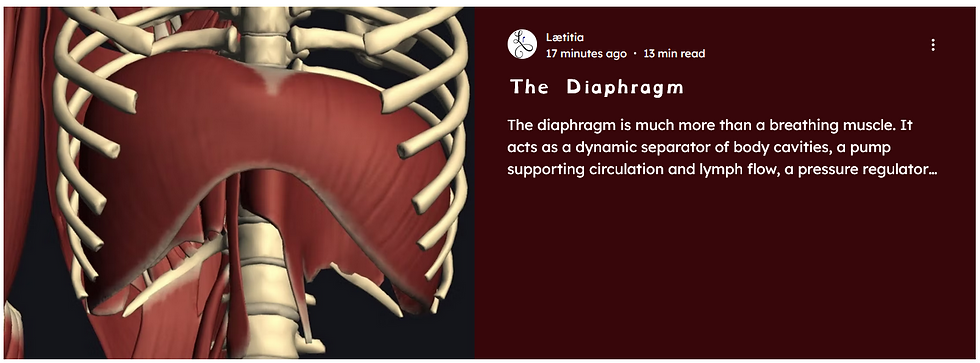
Exercise your diaphragm
Here are three practical breathing exercises designed to strengthen the diaphragm and enhance its role in supporting circulation and venous return:
🌞
1. Diaphragmatic (Belly) Breathing
Purpose: Engages the diaphragm fully to maximize pressure changes that assist venous return.
How to do it:
Sit or lie comfortably with one hand on your chest and the other on your belly.
Inhale slowly through your nose, directing the breath so your belly rises while your chest stays still.
Exhale gently through pursed lips, feeling your belly fall.
Focus on slow, deep breaths—about 5 seconds in, 5 seconds out.
Repeat for 5–10 minutes daily.
Benefits: Encourages deep diaphragm movement, improving thoracoabdominal pressure balance and venous flow.
🌞
2. Coordinated Breath and Leg Movement
(Leg Elevation Breathing)
Purpose: Combines diaphragm activation with leg elevation to further promote venous return from the lower body.
How to do it:
Lie on your back and elevate your legs against a wall or on a chair at a 45-90° angle.
Place your hands on your belly.
Inhale deeply through your nose, expanding your belly.
Exhale slowly through your mouth, contracting your belly.
Perform 10 slow breaths while keeping your legs elevated.
Repeat twice daily.
Benefits: Elevating legs reduces gravitational resistance, and diaphragmatic breathing enhances the respiratory pump effect.
🌞
3. Pursed-Lip Breathing with Diaphragmatic Focus
Purpose: Prolongs exhalation to maintain lower thoracic pressure, aiding venous return and improving oxygen exchange.
How to do it:
Sit comfortably with good posture.
Inhale slowly through your nose, using diaphragmatic breathing (belly expands).
Purse your lips as if blowing out a candle.
Exhale slowly and steadily through pursed lips for twice as long as inhalation.
Repeat for 5 minutes.
Benefits: Extends exhalation phase, sustaining the pressure gradient that helps blood flow back to the heart.
Tips for All Exercises
Practice in a calm environment to reduce stress and encourage relaxation.
Maintain good posture to allow full diaphragm movement.
Avoid shallow chest breathing; focus on belly expansion.
Consistency is key—daily practice builds strength and circulatory benefits.
These exercises gently train your diaphragm to function as a more effective respiratory pump, supporting your heart and circulation like the steady rhythm of ocean waves nurturing the shore.

Posture tips and core exercises
Here are some posture tips and core exercises that complement your diaphragm-strengthening breathing exercises, enhancing overall respiratory efficiency and circulatory support.
For Optimal Diaphragm Function
Sit or Stand Tall
Keep your spine straight, shoulders relaxed and back, and chest open.
Avoid slouching or leaning forward, which compresses the diaphragm and restricts its movement.
Neutral Pelvis Alignment
Whether sitting or standing, keep your pelvis in a neutral position—not tilted too far forward or backward.
This alignment supports diaphragm movement and core stability.
Relax Your Neck and Shoulders
Tension here can limit chest expansion and promote shallow breathing.
Gently roll your shoulders back and down, and lengthen your neck.
Use Support When Needed
When sitting, use a chair with good lumbar support or place a small cushion behind your lower back. This encourages natural spinal curves and allows full diaphragm motion.
Regular Movement Breaks
Avoid prolonged sitting or static postures.
Stand, stretch, and take deep breaths every hour to reset posture and diaphragm function.
Core Exercises Supporting Diaphragm and Postural Stability
Good posture creates the ideal environment for your diaphragm to move freely, while core exercises stabilize your trunk, enhancing breathing efficiency and circulatory support. Together with breathing exercises, these habits build a resilient, well-functioning respiratory and circulatory system—like a strong tree trunk supporting healthy, expansive branches.
Would you like a simple daily routine combining these exercises and posture tips?
🌞
1. Pelvic Tilts
Lie on your back with knees bent and feet flat on the floor.
Gently tilt your pelvis backward, flattening your lower back into the floor.
Hold for 3–5 seconds, then release to a neutral spine.
Repeat 10–15 times.
Benefits: Strengthens lower abdominal muscles and supports diaphragm by stabilizing the core.
🌞
2. Bridge Pose
Lie on your back with knees bent, feet hip-width apart.
Press your feet into the floor and lift your hips toward the ceiling.
Engage your glutes and core, keeping your shoulders relaxed.
Hold for 10–20 seconds, then slowly lower down.
Repeat 8–12 times.
Benefits: Activates the core and pelvic muscles, improving posture and diaphragm efficiency.
🌞
3. Seated or Standing Side Bends
Sit or stand tall with arms at your sides.
Slowly bend sideways at the waist, reaching your right hand down the side of your leg.
Return to center and repeat on the left side.
Perform 10 bends on each side.
Benefits: Stretches and strengthens the lateral muscles of the torso, promoting flexibility and allowing freer diaphragm movement.
Integrating Breathing with Core Work
While doing these exercises, focus on diaphragmatic breathing to engage the core and diaphragm simultaneously. For example, inhale deeply as you prepare for the movement and exhale slowly while performing the exertion phase (like lifting hips in the bridge).
3 exercises to improve diaphragm coordination with core and pelvic floor muscles.
Here are three effective exercises designed to improve the coordination of your diaphragm with core and pelvic floor muscles, enhancing intra-abdominal pressure regulation and overall core stability.
🌞
1. Diaphragmatic Breathing with Pelvic Floor Engagement
Purpose: Synchronizes diaphragm movement with pelvic floor activation to build core stability.
Sit or lie comfortably with knees bent and feet flat.
Place one hand on your belly and the other on your pelvic area (just above the pubic bone).
Inhale deeply through your nose, allowing your belly to rise as the diaphragm contracts.
At the same time, gently lift and contract your pelvic floor muscles (as if stopping urine flow).
Exhale slowly through pursed lips, relaxing the pelvic floor and allowing the belly to fall.
Repeat for 8–10 breaths, focusing on smooth, coordinated movement.
Benefits: Trains the diaphragm and pelvic floor to work together, improving pressure control and core support.
🌞
2. Core Bracing with Diaphragmatic Breathing
Purpose: Enhances coordination between diaphragm, abdominal muscles, and pelvic floor.
Lie on your back with knees bent and feet flat.
Place your hands on your lower ribs and belly.
Inhale deeply through your nose, expanding your belly and lower ribs.
As you exhale slowly, engage your transverse abdominis (the deep abdominal muscle) by gently drawing your belly button toward your spine.
Simultaneously, contract your pelvic floor muscles.
Maintain this gentle brace throughout the exhale.
Repeat for 10 breaths.
Benefits: Strengthens the deep core muscles while integrating diaphragm and pelvic floor function for better intra-abdominal pressure regulation.
🌞
3. Bridge with Breath and Pelvic Floor Activation
Purpose: Combines core strengthening with diaphragm and pelvic floor coordination.
Lie on your back with knees bent, feet hip-width apart.
Inhale deeply through your nose, expanding your belly (diaphragm contracts).
As you exhale, engage your pelvic floor and abdominal muscles and lift your hips into a bridge position.
Hold the bridge while maintaining pelvic floor and core engagement.
Inhale to prepare, then exhale to lower hips slowly.
Repeat 8–12 times.
Benefits: Builds core stability and reinforces the timing of diaphragm, pelvic floor, and abdominal muscle activation during movement.
Tips for All Exercises
Move slowly and mindfully, focusing on the connection between breath and muscle engagement.
Avoid excessive tension; contractions should be gentle and controlled.
Practice regularly (3–5 times per week) for best results.
These exercises nurture your body’s internal support system, like tuning an orchestra where the diaphragm, core, and pelvic floor play in harmony to stabilize and empower your movements.

Breathing and movement techniques to optimize lymphatic drainage
Here are specific breathing and movement techniques designed to optimize lymphatic drainage by enhancing diaphragm function and promoting gentle lymph flow:
🌞
Why it helps: Deep, slow breaths maximize diaphragm movement, creating strong pressure changes that gently pump lymph upward.
🌞
2. Box Breathing (Square Breathing)
Inhale through your nose for a count of 4.
Hold your breath for a count of 4.
Exhale slowly through your mouth for a count of 4.
Hold your breath out for a count of 4.
Repeat this cycle 5–8 times.
Why it helps: This controlled breath pattern enhances thoracic pressure fluctuations, stimulating lymphatic flow and calming the nervous system.

Movement Techniques to Support Lymphatic Flow
Combining deep, mindful breathing with gentle, rhythmic movements creates a powerful synergy that enhances diaphragm-driven pressure changes and stimulates lymphatic flow.
These practices nurture your immune system, reduce fluid buildup, and promote overall vitality—much like a flowing river cleansing and nourishing the landscape.
🌞
1. Gentle Rebounding (Mini-Trampoline)
Use a small rebounder or mini-trampoline.
Bounce gently with feet barely leaving the surface, keeping your body relaxed.
Continue for 5–10 minutes.
Why it helps: The up-and-down motion stimulates lymphatic vessels, while diaphragm-driven breathing enhances pressure changes that promote lymph flow.
🌞
2. Yoga-Inspired Movements with Breath Focus
Practice gentle yoga poses like Cat-Cow, Child’s Pose, and Legs-Up-The-Wall.
Coordinate movements with deep diaphragmatic breathing.
For example, inhale during extension (Cow Pose), exhale during flexion (Cat Pose).
Why it helps: These movements gently compress and decompress the abdomen and chest, aiding lymphatic drainage alongside diaphragm action.
🌞
3. Walking with Conscious Breathing
Walk at a comfortable pace.
Focus on deep, rhythmic diaphragmatic breaths—inhale deeply through the nose, exhale fully through the mouth.
Maintain an upright posture to allow full diaphragm expansion.
Why it helps: Walking activates muscle pumps in the legs and, combined with deep breathing, supports lymph and venous return.

3 exercises to improve diaphragmatic breath control
Here are three effective exercises to improve diaphragmatic breath control, enhancing vocal power, endurance, and clarity for speech and singing.
🌞
1. Diaphragmatic Breathing with Hissing Sound
Purpose: Develops control over breath release and strengthens diaphragm engagement.
Sit or stand with good posture.
Take a deep breath through your nose, expanding your belly.
Exhale slowly through your teeth while making a steady “sss” hissing sound.
Aim to sustain the hiss for as long as possible with a steady airflow.
Repeat 5 times, gradually increasing the duration.
Benefits: Trains steady airflow control essential for sustained vocalization and smooth speech.
🌞
2. Sustained Vowel Sounds on Exhale
Purpose: Builds breath support and vocal cord coordination.
Inhale deeply using diaphragmatic breathing.
On a comfortable pitch, exhale while sustaining a vowel sound (e.g., “ah,” “ee,” or “oo”).
Hold the sound steadily for as long as possible without strain.
Focus on keeping the airflow smooth and consistent.
Repeat 5–8 times, resting between attempts.
Benefits: Enhances control over breath pressure and vocal tone stability.
🌞
3. Controlled Pitch Glides (Sirens)
Purpose: Improves breath control while exploring vocal range.
Take a deep diaphragmatic breath.
Start on a low pitch and smoothly glide your voice upward to a high pitch, then back down, like a siren.
Keep the airflow steady and avoid pushing or straining.
Repeat 5 times, focusing on smooth transitions and breath control.
Benefits: Strengthens diaphragm support for dynamic vocal modulation and pitch control.
Tips for All Exercises
Maintain relaxed shoulders and neck.
Use good posture to allow full diaphragm movement.
Avoid tension in your throat or jaw.
Practice regularly, gradually increasing duration and control.
These exercises help you harness your diaphragm’s power, turning breath into clear, strong, and expressive voice—like tuning a fine instrument for your personal symphony.

3 exercises that integrate diaphragm training with posture and core strengthening
Here are three effective exercises that integrate diaphragm training with posture and core strengthening to enhance spinal stability and overall body support.
🌞
1. Diaphragmatic Breathing with Core Bracing
Purpose: Strengthens the diaphragm while engaging deep core muscles to support posture.
Sit or lie comfortably with a neutral spine.
Place one hand on your belly and the other on your chest.
Inhale deeply through your nose, expanding your belly while keeping your chest still.
As you exhale slowly, gently draw your belly button toward your spine to engage the transverse abdominis (deep core muscle).
Maintain this gentle core brace while continuing diaphragmatic breathing for 5–10 breaths.
Repeat 2–3 times daily.
Benefits: Builds diaphragm strength and core stability, promoting upright posture.
🌞
2. Bird-Dog with Breath Control
Purpose: Enhances core stability and coordination between diaphragm and back muscles.
Start on hands and knees in a tabletop position with a neutral spine.
Inhale deeply through your nose, expanding your belly.
As you exhale slowly, engage your core and pelvic floor, then extend your right arm forward and left leg back, keeping hips level.
Hold for 3–5 seconds while maintaining steady diaphragmatic breathing.
Inhale as you return to starting position.
Repeat on the opposite side.
Perform 8–10 repetitions per side.
Benefits: Trains spinal stability and diaphragm coordination during dynamic movement.
🌞
3. Wall Roll-Down with Diaphragmatic Focus
Purpose: Improves posture alignment and integrates diaphragm breathing with spinal mobility.
Stand with your back against a wall, feet hip-width apart, about 6 inches from the wall.
Tuck your chin slightly and press your lower back gently into the wall.
Inhale deeply, expanding your belly and ribcage.
Slowly exhale and roll your spine forward one vertebra at a time, bending at the hips.
Keep your abdominal engagement and pelvic floor active as you roll down.
Inhale at the bottom, then exhale as you slowly roll back up to standing, maintaining core engagement.
Repeat 5–8 times.
Benefits: Enhances spinal flexibility, posture awareness, and diaphragm-core integration.
Tips for All Exercises
Maintain relaxed shoulders and neck.
Focus on smooth, controlled breathing.
Avoid holding your breath; keep diaphragm engaged throughout.
Practice regularly for best results.
These exercises build a resilient core “canister” with the diaphragm as a central pillar, supporting your posture and protecting your spine—like roots anchoring a tall, graceful tree.


Comments